Why the EIC Accelerator Now Offers Six Application Deadlines a Year
Europe's EIC Accelerator moves to six application deadlines a year in 2026, offering €634 million in blended grant and equity funding.
The European Innovation Council Accelerator offers deep-tech startups outside the US a path to capital that splits the difference between grants and equity. Since 2026, it has moved to six application deadlines a year — January, March, May, July, September, and November — replacing the previous two annual windows. The shift lowers the cost of timing mistakes and makes the program’s €634 million budget more accessible to founders outside the venture hubs that dominate quarterly funding rounds.
The EIC Accelerator is built for companies that have moved past research but not yet into full commercialization. It blends non-dilutive funding (a grant of up to €2.5 million) with equity investment (€1 to €10 million) from the EIC Fund, a dedicated vehicle created because standard EU grant rules do not allow the Commission to hold company shares. Founders can request grant-only, equity-only, or a blend of both, weighing dilution against non-repayable capital.
The Blended Finance Model: Non-Dilutive Plus Equity
The EIC Accelerator’s funding package is unusual in European startup programs. The grant component — up to €2.5 million — covers innovation activities, prototyping, testing, and market launch. Founders keep that money and do not repay it. The equity component, managed by the EIC Fund, is a direct minority stake in the company, typically between €1 and €10 million. The EIC Fund holds this stake until the company matures enough to attract fully private financing, then exits.
The intended effect is that the EIC’s involvement is time-limited. Founders do not face a permanent public shareholder, but they also do not get to choose the EIC Fund as a co-investor. This patient-capital model works because the EIC Fund has no pressure to exit on a fixed timeline like private venture funds do; it can hold longer and tolerate more technical risk.
The EIC Fund’s equity stake is designed to co-invest alongside private investors on pari-passu terms — same price, same rights — rather than substitute for private capital. This is especially relevant for capital-intensive, high-risk sectors like fusion, advanced materials, and climate tech, which the program’s thematic Challenges also target.
2026 Application Timeline
The EIC Accelerator moved to six cut-off dates in 2026: January 7, March 4, May 6, July 8, September 2, and November 4. Jury interviews follow each pair of cuts.
Who Qualifies: Technology Stage and Company Profile
Eligible applicants are single startups or SMEs incorporated in EU Member States or Horizon Europe-associated countries. The company must have fewer than 250 employees and annual turnover below €50 million. University spin-outs qualify, as do natural persons (founders without incorporation yet) who intend to establish a company. Small mid-caps — companies with up to 499 employees — can apply, but only for TRL 9 activities and with equity investment only, no grant.
The technology itself must sit in the mid-to-late development range. The program targets Technology Readiness Level 6 through 8: the technology already works in a relevant or operational environment, not an early-stage research concept. Companies need a working prototype, evidence of technical feasibility, and a credible commercialization plan. Most rejections come not from weak underlying technology but from weak evidence: vague market sizing, unconvincing intellectual-property strategy, or unclear technical feasibility claims.
Unlike most Horizon Europe instruments, the EIC Accelerator is built for single applicants, not consortia. A founder does not need partners in other countries or complementary organizations to apply. That design choice reflects the program’s target: founders and CEOs with decision-making authority who can move fast.
The Six-Cutoff Calendar: What Changes for Applicants
In 2025 and before, the EIC Accelerator ran two main cut-offs per year. In 2026, it shifted to six: January 7, March 4, May 6, July 8, September 2, and November 4. This change compresses the window between application and result.
The workflow remains the same across all six cuts. A short proposal (Step 1) can be submitted at any time; there is no deadline. If it receives a positive signal, the founder submits a full proposal to one of the six batching dates. Short proposals get feedback within 4 to 6 weeks. Full proposals, capped at 20 pages plus annexes, are evaluated within 8 to 9 weeks. Jury interviews happen three times per year, each following two cut-off batches.
More frequent cuts mean founders no longer wait a full year if they miss a deadline. A company rejected in January can reapply with improved evidence in March. For programs that move fast — Series A fundraising, product-market fit validation, regulatory milestones — six windows offer more tactical flexibility than two. The flip side: more frequent cuts do not change the denominator, only the timing. The EIC Accelerator still faces massive demand relative to supply.
The EIC’s involvement is time-limited; founders do not face a permanent public shareholder, but they also do not get to choose the EIC Fund as a co-investor.
The Odds of Getting Funded: Supply, Demand, and Selectivity
In the October 2025 cut-off, 61 companies received funding from 923 full applications submitted. The end-to-end success rate across all stages is approximately 3 percent — roughly one in 33 applications reaches funding.
The pathway is tiered. About 70 percent of short proposals pass and receive an invitation to submit a full proposal. Of those full proposals, 13 to 20 percent advance to interview. Of the interviewed companies, 44 to 50 percent receive funding. Recent cut-offs show variation: the October 2025 round funded 6.6 percent of full proposals, while the January-to-March 2026 window funded 8.6 percent. The difference reflects both company cohort quality and jury preferences by thematic focus.
Demand vastly outpaces supply. At the October 2025 cut-off alone, applicants requested nearly €7 billion in funding against the program’s 2026 annual budget of €634 million. The mismatch is structural. Deep-tech companies are capital-hungry, and the EIC Accelerator is one of the few sources in Europe that accepts blended finance for that stage and sector. For founders, the implication is clear: getting past the short-proposal stage is necessary but not decisive. The full proposal must convert weakly specified ideas into fact-backed arguments. Market size claims need sources. Technical feasibility needs evidence. Intellectual-property strategy needs depth.
Strategic Themes: Where €220 Million of the Budget Flows
The 2026 program maintains five thematic ‘challenges’ that channel €220 million toward specific sectors. These are not restrictions — founders can still apply for general funding — but they receive priority consideration.
The themes are: advanced materials for renewable energy (€50 million), fusion technology concepts (€20 million), agricultural soil regeneration biotechnology (€50 million), critical raw materials supply chain (€50 million), and climate adaptation deep tech (€50 million). Each reflects a European policy priority: energy transition, industrial autonomy, food security, and resilience.
A deep-tech company working in one of these sectors does not face a higher bar for technical credibility. But reviewers have more budget headroom to fund borderline candidates in thematic areas, and founders should signal alignment clearly if their company fits. The program also raised its minimum blended finance ticket from €500,000 to €1 million in 2026, meaning founders cannot seek an EIC check smaller than that. For very early-stage deep-tech companies, that floor may be prohibitive until they can scale toward commercialization.
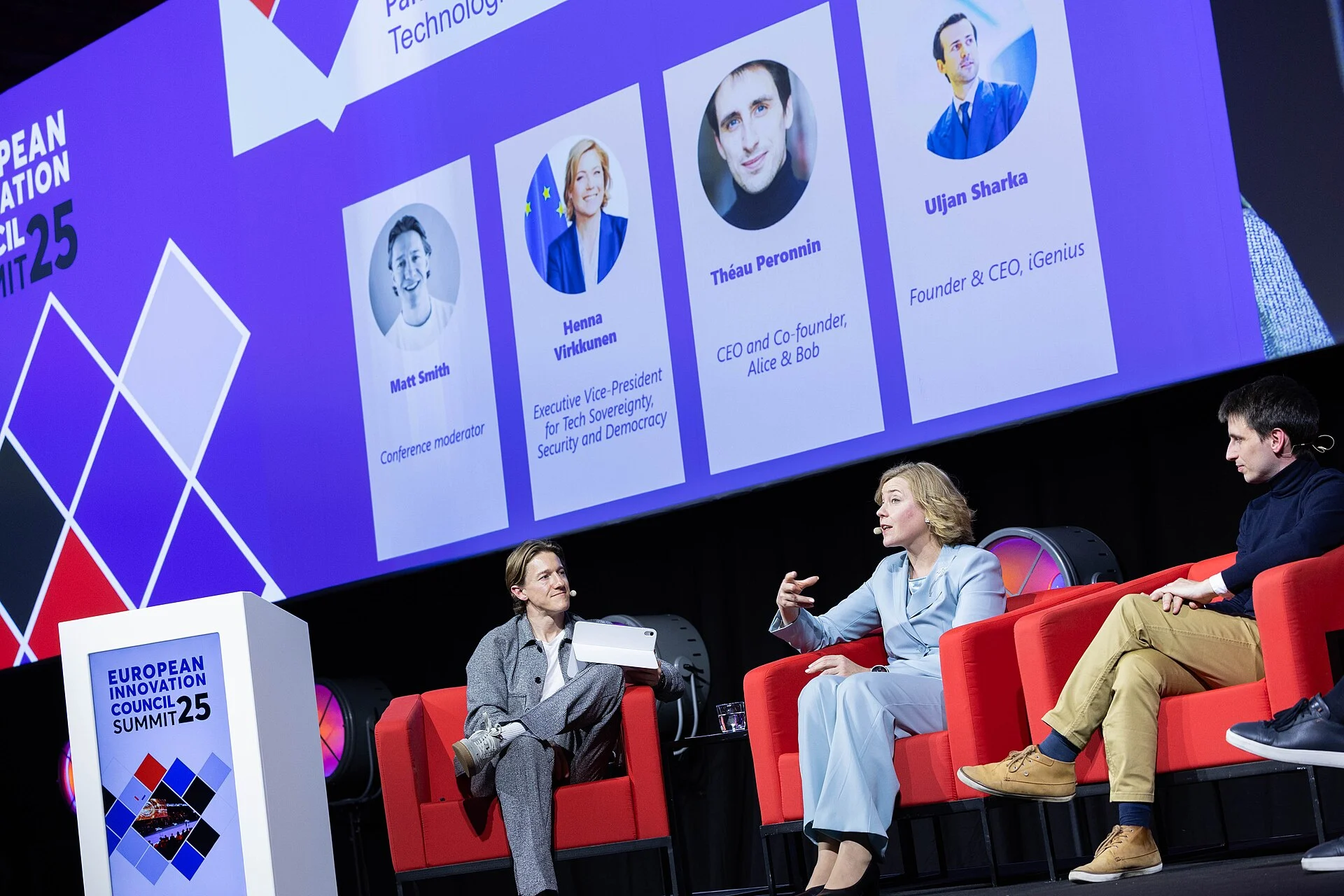
Photo: Europäische Kommission – Audiovisueller Dienst, Jennifer Jacquemart, Yügen, CE – · CC BY 4.0
Get more stories like this in your inbox by signing up for the EW newsletter, The Entrepreneurs Weekly’s free digest of founder stories and business news.